
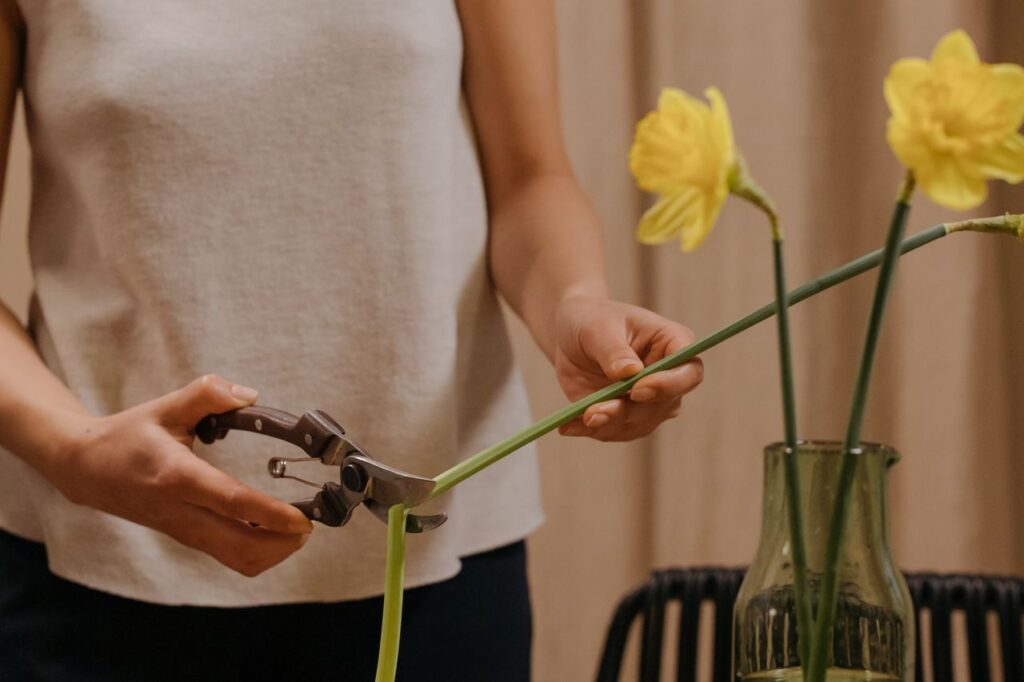
Taking a quick snip at a yellowing leaf with whatever pair of scissors happens to be lying on your desk can feel completely harmless in the moment.
In my early days as a plant parent, I reached for standard kitchen scissors all the time to trim damaged foliage or harvest quick propagation cuttings, assuming a blade was simply a blade.
However, using the wrong cutting tool on delicate stems is one of the quickest ways to cause hidden tissue damage, invite fungal infections, and stunt fresh growth.
In this guide, I will break down the essential differences between pruning shears and household scissors, explain the mechanical damage caused by crushing plant stems, and show you how to trim your indoor foliage safely.
The Mechanical Difference: Clean Cut vs. Stem Crush
To understand why specialized garden tools matter, it helps to look at how different blades make physical contact with living plant tissue.
Standard household kitchen or craft scissors rely on two flat blades that press together directly, creating a pinching motion designed for paper or fabric.
When applied to a thick stem, standard scissors crush the vascular tissues—known as the xylem and phloem—before finally cutting through the outer skin.
I learned this lesson after noticing that every Pothos vine I cut with craft scissors developed a brown, mushy end instead of clean, fresh roots.
In contrast, professional bypass pruning shears feature a sharp curved blade that glides smoothly past a thicker counter-blade, operating like a razor-sharp shearing knife.
This scissor-action mechanism makes a clean, precise slice through living stem tissue without squeezing, tearing, or crushing vital internal pathways.
The Danger of Crushed Vascular Pathways
When plant stems suffer crush injuries from dull or flat-bladed scissors, the internal damage extends far beyond the immediate surface slice.
Damaged, bruised stem tissue cannot seal itself efficiently, leaving an open, ragged wound that oozes fluid and remains vulnerable for days.
These open, bruised cuts create an ideal entry point for airborne fungal spores, bacterial rot, and opportunistic household pests like fungus gnats.
Furthermore, a crushed cut often dies back several inches past the initial slice, turning brown and preventing dormant nodes from pushing out fresh growth.
By making a clean, swift slice with sharp shears, you allow the plant to form a healthy, dry callus within hours, protecting the stem from decay.
Tool Selection Guide: Matching the Blade to the Stem
Not every pruning task requires heavy-duty shears, and knowing which tool to pick for different stem thicknesses prevents accidental plant injury:
| Cutting Tool | Ideal Plant Task | Blade Mechanism | Stem Thickness Limit |
| Bypass Pruners | Living stems, woody vines, thick petioles | Curved blade glides past anvil | Up to 3/4 inch thick |
| Anvil Pruners | Dead, dry branches and tough woody stems | Straight blade presses onto flat block | Up to 1 inch (Dead wood only) |
| Precision Micro-Snips | Harvesting cuttings, trimming delicate leaves | Fine, pointed bypass blades | Up to 1/8 inch thick |
| Household Scissors | Paper, twine, plastic pots (Avoid on living plants) | Flat pinching blades | Not suitable for living stems |
Bypass vs. Anvil Pruners: Knowing the Difference
When shopping for garden tools, you will quickly notice two distinct styles of pruners on the shelves: bypass and anvil shears.
Bypass pruners feature two curved blades that pass each other like traditional scissors, making them my absolute go-to choice for living plants, soft tropical stems, and fresh green vines.
Anvil pruners feature a sharp straight blade that closes directly onto a flat, solid surface made of brass or hard plastic.
While anvil pruners exert massive crushing force, they should never be used on living tropical stems, as the chopping motion completely flattens soft green tissues.
I reserve anvil pruners exclusively for cutting away hard, dead branches or pruning dry, woody outdoor shrubs where stem crushing doesn’t matter.
Essential Sanitation: Preventing Cross-Contamination
Even the highest-quality bypass pruning shears can become a vehicle for disease if you do not sanitize the blades between cuts.
Using unsterilized shears on an infected plant and immediately trimming a healthy Monstera easily transfers microscopic bacteria, viruses, and fungal spores across your collection.
Sterilizing your cutting tools takes only a few seconds, and I make it a strict rule to clean my tools before moving to another plant pot.
My Go-To Sanitation Protocol
- Rubbing Alcohol: Wipe down both sides of the metal blades with a cotton pad soaked in 70% isopropyl alcohol before moving to a new plant.
- Diluted Bleach Solution: Soak blades in a solution of one part household bleach to nine parts water for two minutes, then dry thoroughly to prevent rust.
- Flame Disinfection: For quick precision work, pass the metal cutting edge through a small flame for a few seconds to eliminate lingering bacteria.
Proper Pruning Technique Step-by-Step
Using proper technique ensures your plant heals rapidly and directs its energy into pushing out vibrant new leaves.
Always locate the nearest leaf node—the swollen joint on the stem where fresh leaves and roots emerge—before making your cut.
Position your bypass pruners roughly a quarter-inch above the node, angling the blade at a 45-degree angle away from the directional bud.
Angling the cut prevents water from pooling on top of the fresh wound, reducing the risk of fungal growth around the node.
Avoid leaving long, unsightly stem stumps above the node, as these unsupplied sections will naturally die back, turn brown, and rot.
Here is a short video on how to prune your plants! Check it out.
Maintenance Tips for Sharp, Long-Lasting Shears
Keeping your pruning shears in top mechanical condition ensures effortless cuts every time and extends the lifespan of your investment.
Dull blades drag through stems rather than slicing cleanly, causing the exact same tissue crushing as standard household scissors.
I sharpen my pruners regularly using a small diamond sharpening file, maintaining the original bevel angle on the main cutting blade.
After every pruning session, wipe the blades clean of sticky plant sap, dry them completely, and apply a light coat of mineral oil to prevent rust.
Store your shears in a dry drawer or sheath, and never use your dedicated plant tools to cut wire, thick plastic, or heavy cardboard.
Invest in the Right Tools for a Flourishing Jungle
Trimming your indoor tropicals shouldn’t feel like a risky gamble that leaves your foliage scarred, bruised, or susceptible to rot.
By swapping out flat household scissors for sharp, sterile bypass pruning shears, you protect your plants’ vascular systems and promote rapid healing.
Inspect your tool kit today, give your pruners a fresh wipe with rubbing alcohol, and give your indoor garden the clean, precise cuts it deserves!
Want to master more advanced plant propagation and maintenance skills? Explore the rest of our blog guides to discover expert soil recipes, indoor lighting advice, and seasonal care routines for every plant parent!
 Small Spaces
 Turn your small space into an urban jungle! Discover step-by-step how to build a mess-free, freestanding living green wall divider for ultimate apartment privacy.
 Plant Care
 Dust is a silent killer! Learn step-by-step how to clean houseplant leaves naturally to boost photosynthesis, prevent pests, and restore vibrant shine.
 Plant Care
 As a pet owner, bringing new plants into your home can feel like a risky game. Curiosity often gets the […]
