
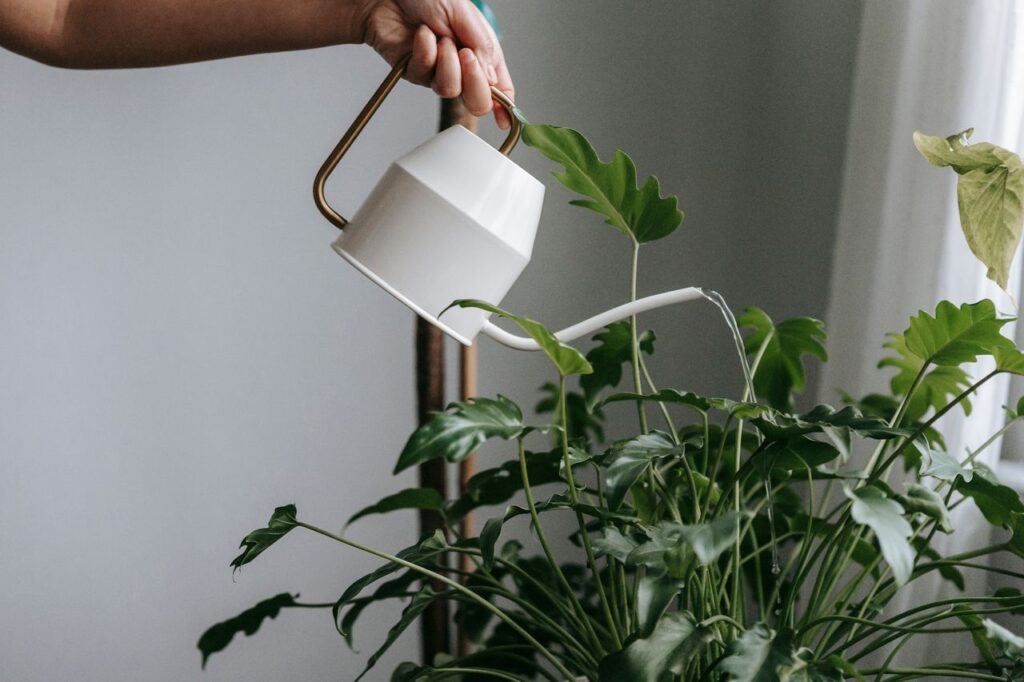
Nothing panics a plant parent quite like watching a beloved green companion droop, drop leaves, or turn a sickly shade of yellow overnight.
In my early days of collecting tropicals, I assumed that any drooping leaf was a desperate cry for hydration, so I would immediately reach for my watering can.
That well-intentioned habit cost me several prized Monsteras before I realized the cruelest joke in indoor gardening: a houseplant dying of thirst looks remarkably similar to one that is literally drowning in stagnant water.
Reaching for your watering can out of pure instinct can either save your plant’s life or deliver the final fatal blow to its rotting roots.
In this guide, I will walk you through how I read subtle leaf signals, inspect soil moisture accurately, and diagnose the exact difference between overwatering and underwatering based on years of hands-on experience in my own home jungle.
The Root Science: Why the Symptoms Look So Similar
To understand why overwatered and underwatered plants look nearly identical above the soil line, we have to look at what happens below the surface in the root zone.
Underwatering is straightforward: without moisture in the soil matrix, the plant cannot draw water up its stems, causing leaves to lose internal cell pressure, wilt, and dry out.
Overwatering is far more insidious in my experience. Prolonged saturated soil starves roots of oxygen, creating an anaerobic environment where fungal pathogens thrive, causing root tissues to rot, turn black, and decompose.
Because an overwatered plant with rotted roots no longer has functional root hairs to absorb liquid, its top foliage starves for hydration—causing it to droop and wilt exactly like a thirsty plant.
Distinguishing between physical drought and root suffocation requires looking closely at leaf texture, container weight, and root health rather than relying on leaf droop alone.
Key Differences: Leaf Texture, Color, and Soil Signals
When I am troubleshooting a struggling plant in my collection, I ignore the overall leaf droop for a moment and focus entirely on leaf texture and soil indicators.
An underwatered plant produces paper-thin, crispy leaves that feel completely dry to the touch and crack easily when I gently bend them between my fingers.
By contrast, an overwatered plant develops soft, limp, yellowing foliage that feels mushy, water-logged, or unusually squishy when I touch the leaf surface.
I also pay close attention to the soil behavior inside the planter: underwatered soil shrinks away from the inner edges of the pot, creating a visible gap and leaving the container feeling feather-light when I lift it.
Overwatered soil remains dark, heavy, and wet for weeks on end, often emitting a sour, musty odor accompanied by white surface mold or tiny fungus gnats hovering around the pot.
Here are some visual insights for you:
Symptom Comparison Matrix
To help you diagnose your plant’s exact condition in seconds, I put together this diagnostic comparison guide based on the symptoms I check first:
| Plant Feature | Overwatered Plant | Underwatered Plant |
| Leaf Texture | Soft, limp, mushy, or water-soaked | Crispy, paper-thin, dry, or brittle |
| Foliage Color | Pale yellow, brown mushy spots, yellow halos | Brown crispy tips, faded pale green, brown margins |
| Leaf Retention | Old and young leaves drop while still soft | Lower leaves turn brown, shrivel, and fall off dry |
| Soil Texture | Wet, soggy, compacted, or smelling sour | Hard, cracked, pulled away from pot edges |
| Pot Weight | Remarkably heavy when lifted | Extremely light when lifted |
| Root Condition | Black, brown, soft, slimy, or foul-smelling | Crisp, dry, papery, brown, but intact |
How I Fix an Underwatered Plant Safely
Rescuing a severely dehydrated plant is relatively simple, but pouring water straight onto bone-dry, hydrophobic soil can actually backfire if you aren’t careful.
When soil stays dry for too long, peat moss and coco coir shrink and begin repelling liquid, causing poured water to run straight down the inner sides of the pot without soaking the central root ball.
Whenever I find a plant that I accidentally let dry out completely, I skip top-watering entirely and use the bottom-watering method to rehydrate the root ball evenly.
- Fill a Basin: I place my potted plant (in its draining plastic nursery pot) into a tub or deep dish filled with three inches of lukewarm water.
- Let It Absorb: I allow the soil to draw moisture upward through the bottom drainage holes via capillary action for twenty to thirty minutes.
- Check the Topsoil: Once the top layer of soil feels damp to my touch, I lift the pot out and let excess water drain completely before returning it to its decorative display saucer.
How I Rescue an Overwatered Plant from Root Rot
Saving an overwatered plant requires immediate surgical intervention to stop fungal decay from destroying what remains of the healthy root system.
In my early years, I made the mistake of hoping an overwatered plant would simply “dry out” on its own, but leaving roots in soggy, anaerobic soil almost always leads to total collapse.
- Unpot the Plant: I gently slide the plant out of its container and carefully brush away saturated, sour soil from around the root system.
- Prune Rotted Roots: I use sterilized pruning shears to snip away all black, slimy, or foul-smelling roots until I am left with only firm, light-colored root tissue.
- Repot in Fresh Mix: I repot the plant into a clean container filled with a fresh, chunky potting mix containing extra perlite and orchid bark for maximum aeration.
- Hold the Water: I hold off on watering for three to four days to allow trimmed root wounds to callous over safely inside the airy soil mix.
Establishing a Foolproof Watering Routine
Preventing moisture mistakes in my indoor jungle came down to abandoning strict calendar routines and learning to read environmental cues instead.
My houseplants consume water at drastically different rates depending on room temperature, seasonal light levels, air humidity, and whether they sit in terracotta or plastic pots.
Instead of watering every single Monday, I test soil moisture using my finger inserted two inches deep, or I physically lift the pot to judge its weight before adding a single drop.
When in doubt, I always remind myself of the golden rule of indoor plant care: it is far easier to save an underwatered plant than to recover a plant ruined by severe root rot!
Want to master more essential houseplant care strategies? Explore the rest of our blog guides to discover specialized soil recipes, pest control solutions, and expert care routines for every plant parent!
 Small Spaces
 Turn your small space into an urban jungle! Discover step-by-step how to build a mess-free, freestanding living green wall divider for ultimate apartment privacy.
 Plant Care
 Dust is a silent killer! Learn step-by-step how to clean houseplant leaves naturally to boost photosynthesis, prevent pests, and restore vibrant shine.
 Plant Care
 As a pet owner, bringing new plants into your home can feel like a risky game. Curiosity often gets the […]
