
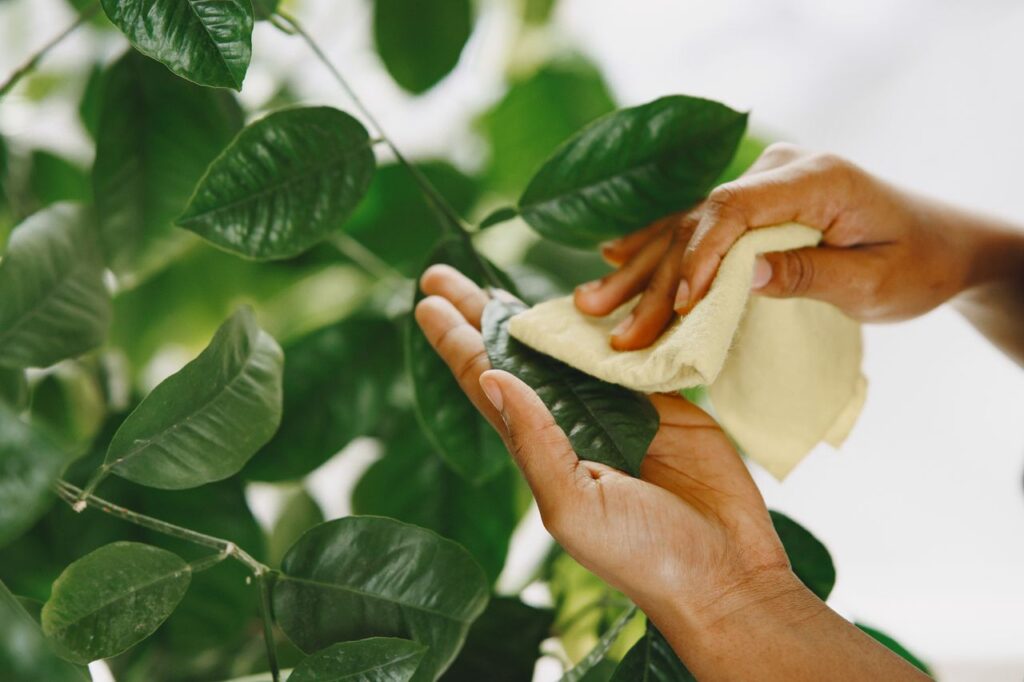
Imagine the scene: you step into your living room on a bright Sunday morning, carrying a fresh cup of coffee, ready to admire your thriving indoor jungle.
But as the sunlight streams through the window, it catches the broad leaves of your favorite Ficus elastica and Monstera deliciosa, revealing a thick, gray blanket of velvety dust, dried water spots, and grime.
It is a subtle shift that happens so slowly we rarely notice it day-to-day. In my early years as an indoor gardener, I viewed dusty foliage as a minor cosmetic annoyance—something to wipe down only when guests were coming over.
It took watching my prized tropicals stall in growth, turn dull, and attract stubborn pest outbreaks for me to realize that dust is actually a silent killer in the indoor environment.
In this guide, I will walk you through the plant science behind foliage hygiene, show you my personal step-by-step cleaning routine, and expose the dangerous commercial leaf shine products you should avoid at all costs.
The Plant Science: Why a Layer of Dust Is Lethal
To understand why dust harms indoor foliage, we have to look at how leaves interact with light and air on a microscopic level.
Outside in nature, plants benefit from regular rainfall, wind currents, and natural atmospheric movement that wash away accumulated debris continuously.
Inside our homes, static air allows household dust, pet dander, cooking grease, and fireplace ash to settle undisturbed across flat leaf surfaces.
This accumulation creates a physical barrier that severely disrupts two essential biological functions:
- Photosynthesis Inhibition: Dust particles act like a shade cloth, reflecting incoming light photons before they reach chlorophyll cells inside the leaf. When plants cannot absorb light efficiently, their energy production drops, leading to stunted growth, pale color, and smaller leaf expansion.
- Stomatal Blockage: Leaves breathe through thousands of microscopic pores called stomata, located primarily on leaf undersides and surfaces. Heavy grime clogs these delicate openings, impeding gas exchange and restricting transpiration—the process that pulls water and minerals up from the root ball.
When a plant cannot breathe or process light efficiently, its immune system weakens, making it extraordinarily vulnerable to sap-sucking pests like spider mites, thrips, and scale insects.
The Dark Side of Commercial “Leaf Shine” Sprays
When plant owners notice dull, dusty leaves, their first instinct is often to buy a can of aerosol leaf shine spray from a local garden center.
I made that exact mistake years ago, spraying down my entire collection of Philodendrons to achieve that high-gloss, wet-looking finish seen in magazine photos.
Within two weeks, the glossy coating turned sticky, trapping twice as much dust as before, while several lower leaves turned yellow and dropped.
Commercial leaf shine products are typically formulated with petroleum distillates, waxes, or heavy oils that coat the foliage in an airtight seal.
While they deliver instant artificial shine, those heavy waxes permanently clog stomatal pores, preventing oxygen exchange and burning delicate cell tissues when exposed to bright sunlight.
Natural, breath-free cleaning methods are always safer, cheaper, and far better for long-term foliage health than quick chemical fixes.
Household Cleaning Materials: What Works vs. What Hurts
Before grabing a rag, it is vital to know which common household items safely lift grime and which ones cause permanent leaf scorching:
| Cleaning Material / Method | Is It Safe? | Primary Effect on Foliage | My Personal Recommendation |
| Microfiber Cloth + Lukewarm Water | 100% Safe | Removes dust gently without blocking stomata | My primary go-to method for 90% of my collection |
| Dilute Neem Oil or Insecticidal Soap | 100% Safe | Cleans grime while repelling spider mites & thrips | Best for monthly pest prevention on broad leaves |
| Dilute Lemon Juice or Vinegar | Safe with Caution | Dissolves stubborn white tap water mineral spots | Use sparingly (1 tsp per quart of water) for hard water |
| Mayonnaise or Coconut Oil | Unsafe | Coats leaves in fat, attracts dust, clogs pores | Avoid completely; causes fungal rot & pore blockage |
| Commercial Aerosol Leaf Shine | Unsafe | Leaves heavy petroleum wax, burns in bright light | Avoid completely; starves leaves of oxygen |
Check out this video for a practical guide on how to clean your foliage naturally and mix a simple DIY spray to keep pests away!
Step-by-Step: How I Clean Different Leaf Types
Not all houseplants can be cleaned the same way; wiping a delicate fern or a fuzzy-leafed African Violet with a damp rag will tear tissue or cause fungal rot. Here is how I tailor my cleaning methods based on leaf texture:
1. Large, Smooth, Broad Leaves (Monstera, Ficus, Rubber Trees)
- Support the Leaf: Place one palm underneath the leaf blade to support its weight, preventing the petiole from snapping under pressure.
- Wipe Top and Bottom: Dampen a clean microfiber cloth with lukewarm water. Gently wipe from the central stem outward toward the leaf tip, cleaning both the upper surface and the underside where pests hide.
- Rinse the Cloth: Rinse your cloth frequently in a bucket of clean water so you aren’t spreading dirt from one plant to the next.
2. Small, Dense, Fine Leaves (Pothos, Ferns, Peperomias)
Trying to wipe hundreds of tiny leaves individually with a cloth is frustrating and inefficient.
- Take Them to the Shower: Bring your small and medium plants to the bathroom or kitchen sink.
- Cover the Soil Matrix: Wrap a plastic grocery bag around the base of the pot to keep soil from washing away or over-saturating.
- Gently Shower: Use a handheld showerhead or spray nozzle set to low pressure and lukewarm temperature to wash off accumulated dust in seconds.
3. Fuzzy or Textured Leaves (African Violets, Begonias)
Fuzzy foliage features tiny surface hairs (trichomes) that trap water drops, causing unsightly brown spots or fungal rot if left wet.
- Use a Soft Paintbrush: Keep a clean, soft-bristled makeup brush or artist’s paintbrush dedicated exclusively to plant care.
- Sweep Gently: Gently brush dust particles out of the leaf crevices, working from the center petiole outward to the leaf margins without using any water.
Tackling Hard Water Spots and Mineral Build-Up
If you live in an area with hard tap water or use overhead misting bottles, you have likely noticed stubborn white chalky spots across your foliage.
These spots are mineral deposits (calcium and magnesium) left behind after water evaporates, and plain water will not dissolve them.
Whenever I need to remove mineral crust from my plants, I mix one teaspoon of lemon juice or organic apple cider vinegar into one quart of distilled water.
The mild acid breaks down alkaline mineral bonds effortlessly. Dampen your microfiber cloth with this diluted solution, wipe the spots gently, and finish by wiping with plain distilled water to remove any acidic residue.
Make Foliage Hygiene a Weekly Routine
Maintaining clean leaves is one of the simplest, most rewarding care habits you can establish for your indoor jungle.
By removing dust barriers, flushing away mineral deposits, and shunning harsh commercial shining waxes, you unlock your plant’s natural ability to photosynthesize at peak efficiency.
Inspect your foliage today, check for dust buildup, and give your tropical companions a gentle bath to let their natural vibrancy shine through!
Want to master more essential houseplant care strategies? Explore the rest of our blog guides to discover specialized soil recipes, pest control solutions, and expert care routines for every plant parent!
 Small Spaces
 Turn your small space into an urban jungle! Discover step-by-step how to build a mess-free, freestanding living green wall divider for ultimate apartment privacy.
 Plant Care
 As a pet owner, bringing new plants into your home can feel like a risky game. Curiosity often gets the […]
 Small Spaces
 Stop guessing planter sizes! Master the 2-inch sizing rule to keep your houseplant roots healthy without taking over your living space.
