
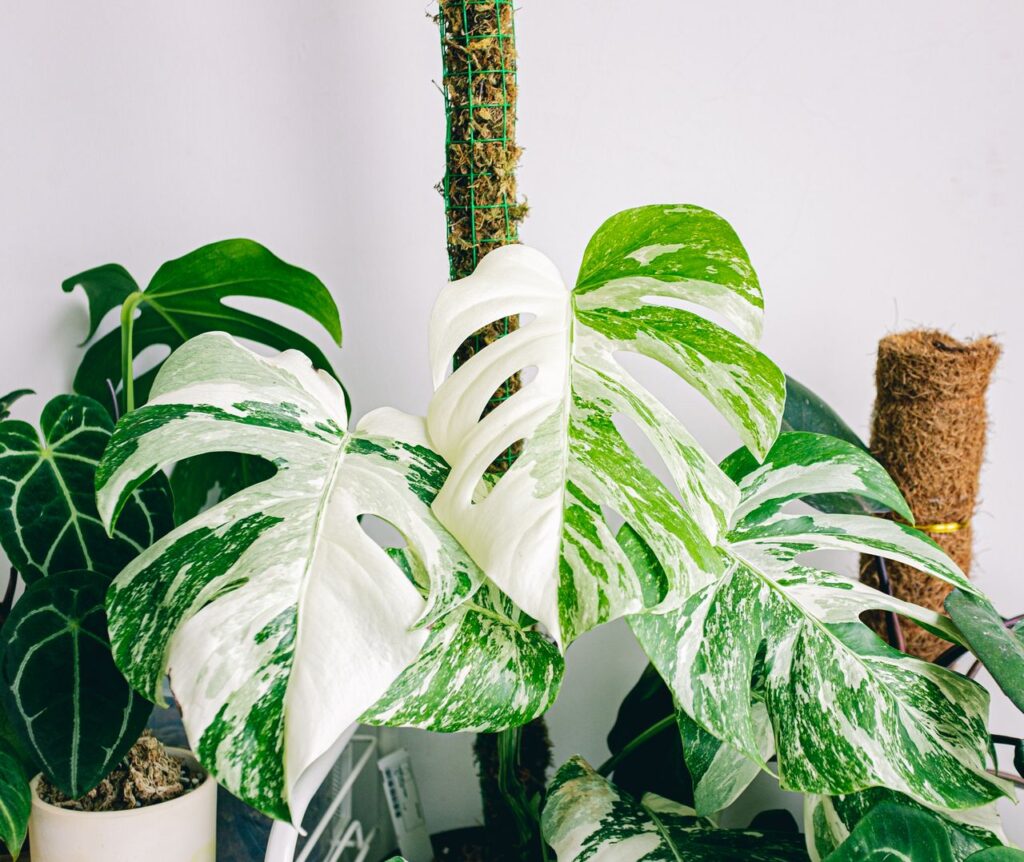
Giving climbing tropicals something to scale isn’t just about keeping messy stems tidy—it directly mimics their natural rainforest habitats.
In my early days as a plant parent, I let my Monstera deliciosa trail wildly across the floor, only to watch its leaves remain small, pale, and completely splitless for months on end.
Once I finally provided a sturdy vertical surface, the transformation was incredible. In the wild, epiphytes like Monstera, Philodendron, and Pothos use aerial roots to grip tree bark as they climb toward the sunny canopy.
Providing vertical support triggers a powerful biological transformation: mature leaves expand significantly, push out dramatic fenestrations (splits), and grow thicker, healthier stems.
In this guide, I will break down the differences between moss poles and trellises, reveal how to install them safely, and show you how to train your vining plants to climb vertically.
Moss Pole vs. Trellis: Which Does Your Plant Need?
Choosing the right support structure depends entirely on how your specific plant species naturally grips climbing surfaces and your maintenance preferences:
| Feature / Need | Sphagnum Moss Pole | Wooden or Metal Trellis |
| How It Works | Damp moss absorbs water; aerial roots sink into it. | Stems are tied or woven around rigid geometric bars. |
| Growth Potential | Maximum (Triggers oversized, mature foliage). | Moderate (Keeps foliage organized and upright). |
| Maintenance | Higher (Requires regular moisture checks). | Low (Set it up once and re-tie occasionally). |
| Best Plant Matches | Monstera, Philodendron, Syngonium, Epipremnum. | Hoya, Ceropegia (String of Hearts), Ivy, Jasmine. |
Note: Coco coir poles are often confused with real moss poles. While coir poles offer sturdy physical support, dry coconut fiber does not retain moisture well, meaning aerial roots won’t penetrate it as easily as damp sphagnum moss.
Why Real Sphagnum Moss Makes Such a Big Difference
Many beginners wonder why a simple stake wrapped in real moss outperforms a wooden rod or plastic trellis for heavy-climbing aroids.
Sphagnum moss acts as an extension of your pot’s soil matrix, holding onto water and liquid nutrients right against the aerial root system.
When an aerial root burrows into a moist sphagnum pole, it transitions into a fully functional subterranean feeder root.
This secondary root network allows the plant to draw double the amount of hydration and fertilizer, speeding up foliage expansion dramatically.
By contrast, dry wooden stakes or metal trellises only offer structural physical support without providing any extra nutrition or moisture.
The Anatomy of a Climbing Epiphyte
To get the most out of vertical supports, it helps to understand how climbing tropicals interact with surfaces in their natural environment.
Epiphytic plants develop two distinct types of roots: subterranean roots that anchor them in the soil, and aerial roots that emerge from stem nodes.
Aerial roots serve two primary functions: physically clinging to textured surfaces and absorbing atmospheric humidity and falling rainwater.
When aerial roots hang in dry indoor air, they eventually turn brown, dry out, and stop developing further.
By providing a damp moss pole, you give these aerial roots the exact microclimate they need to stay active, fleshy, and productive.
Step-by-Step: Installing a Support Pole or Trellis
Installing vertical support is easiest during repotting, as inserting stakes into an established pot can accidentally slice through central root systems.
- Position the Support First: Place your moss pole or trellis into the empty pot before adding the plant. Anchor it firmly against the very bottom of the container.
- Add a Soil Base: Pour a few inches of a chunky, well-draining aroid mix around the base of the support to hold it steady.
- Set the Root Ball: Place your plant next to the pole. Ensure the “back” of the plant—where the aerial roots emerge—is facing directly against the moss surface.
- Fill and Tamp: Fill the remaining space with potting mix, tamping down firmly around the base of the pole to lock it in an upright position.
How to Secure and Train Your Climbing Vines
Plants won’t automatically attach to a new support overnight; they need a little gentle guidance to get started.
- Use Soft Plant Ties: Secure main stems using soft velcro plant tape, green garden twine, or padded wire. Avoid thin, rigid wire or tight plastic zip ties, which can cut into expanding stems as they grow.
- Tie Below the Nodes: Place your ties directly beneath a leaf node (where the leaf stem joins the main vine), as this is where new aerial roots sprout.
- Orient Aerial Roots Correctly: Gently push existing aerial roots against the damp moss so they begin anchoring themselves into the core.
“To get the most out of your moss pole and boost leaf growth, keep these extra tips in mind:
Essential Maintenance for Moss Poles
A dry moss pole functions no differently than a plain wooden stake. To keep aerial roots actively growing into the pole, you must keep the inner sphagnum moss consistently damp.
I recommend watering your moss pole from the top down using a narrow-spout watering can or a squeezed plastic water bottle inverted into the top opening.
As water slowly trickles down through the moss, it hydrates the entire vertical column while supplying a steady stream of moisture directly to the aerial root zone.
If you live in a very dry climate, wrapping the back of your moss pole in plastic film can help slow down evaporation and keep the moss moist for longer periods between waterings.
Troubleshooting Common Moss Pole Issues
Even with the best setups, you might encounter a few minor hurdles while training your tropicals to scale a vertical support.
If your moss pole develops an unpleasant, sour smell, it usually indicates stagnant water pooling at the base or insufficient airflow in the room.
To fix this, allow the pole to dry out slightly more between waterings and increase room ventilation with a small circulation fan.
If aerial roots refuse to dig into the moss, check the moisture level; roots will actively avoid dry sphagnum and wander off into the air instead.
Extending Your Moss Pole as Your Plant Grows
As your tropical climber thrives, it will eventually reach the very top of its vertical support, leaving you with a choice on how to manage its height.
Stackable moss poles allow you to easily insert a new pole section directly into the top of the existing one without disturbing the rooted base.
Alternatively, you can chop and extend: cut the top section of the plant just below a deeply rooted node on the pole, and repot that top section as a fully established, mature plant.
This chop-and-extend method allows you to continuously grow massive, oversized leaves while keeping the plant’s overall height manageable for standard living rooms.
Watch Your Tropical Climbers Take Off
Upgrading your climbing tropicals from trailing hanging baskets to vertical supports is one of the most rewarding milestones in indoor gardening.
Whether you choose a moisture-retentive moss pole for an ambitious Monstera or a stylish metal trellis for a vining Hoya, providing vertical structure will completely transform your collection!
Take a look at your climbing plants today, grab a sturdy support pole, and give your indoor tropicals the vertical foundation they need to reach their full potential!
Want to dive deeper into custom indoor plant setups? Explore our latest blog guides to discover specialized soil blends, lighting setups, and seasonal care tips for every plant parent!
 Small Spaces
 Turn your small space into an urban jungle! Discover step-by-step how to build a mess-free, freestanding living green wall divider for ultimate apartment privacy.
 Plant Care
 Dust is a silent killer! Learn step-by-step how to clean houseplant leaves naturally to boost photosynthesis, prevent pests, and restore vibrant shine.
 Plant Care
 As a pet owner, bringing new plants into your home can feel like a risky game. Curiosity often gets the […]
